


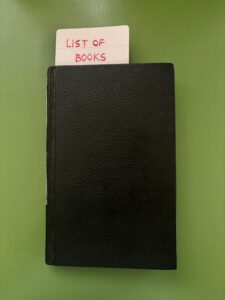
 As a writer, it’s a given I’m also an avid reader. I have a small black journal which contains a list of books I’ve read, starting from 2001. I am a deliberate reader, i.e. slow, and I hate to abandon a book I’ve started. My book lists show my reading selection to be all over the place – from contemporary American to world literature to classic and everything in between. The minute I set myself to read only South Asian women writers and immigrant writers (like this year), a comment about the greatness of Henry James leads me to listen to a recorded version of A Portrait of a Lady, which I loved. The truth is I have nothing against dead white men authors—I have learned so much from them— but I do feel passionately that women’s voices, black voices, native voices, immigrant voices, and those from around the world need a greater place on our bookshelves. As one of those voices, I feel a particularly strong bond with my fellow diasporic writers. That said, I accept that my reading habits will be gloriously arbitrary.
I wish had taken notes over the years on each book and what my response to it was. This blog is the beginning of that enterprise. It invites me to think deeper about each book I read and articulate my thoughts on it. So here we go!
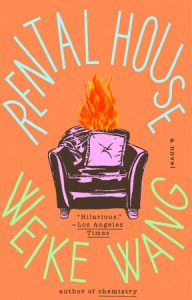 Rental House by Weike Wang (2024) – I started off the year listening to Rental House on audio. (Full disclosure: Weike Wang selected as Sutra Americana as the runner up finalist for the new American Press contest back in 2022 and she wrote a great blurb for the book.) But that’s not why I read her. I read her because she is one of the boldest writers I’ve read, unafraid to step into the hard territory of racial and cultural conflict. She describes the extreme alienation of the second-generation immigrant with chilling effect. Rental House is about a mixed race couple – Keru, Chinese American and Nate, white from a working class family and their English sheep dog Mantou. The rental house refers to two houses they rent, first on Cape Cod, and then one in a suburb outside of New York City. Both sets of parents visit them in the Cape Cod rental house, and Nate’s delinquent brother visits the other. What should be relaxing vacations turn into both characters suffering through their own sense of displacement, while we the reader follow the complicated paths of their upbringings and how their parents’ lives shadow them. Keru is angry, so angry she throws things at people. Nate is so passive he doesn’t report a leak in his university office. They are united in their unspoken desire to escape their pasts—Keru, her parents unrelenting drive for success in America (who cares about happiness), and Nate his parent’s unquestioning adherence to American family values (coded Trump supporters) to find refuge in something that is completely new. Their individual loneliness could be a source of bonding, but Wang keeps them on such far sides from the room from each other. Heartbreaking. If only they could love one another the way they love their dog. This is the third novel of Wang’s that I’ve read, and I look forward to her next.
 The Ice Palace by Tarjei Vesaas (1963) This book came highly recommended by (former)Diesel Bookstore owner John Evans. I had never heard of Vesaas – he’s Norwegian and was a prolific author who was consistently up for the Nobel Prize in Literature. The book lived up the recommendation. It’s the story of two young girls, Siss and Unn, who form a brief friendship before Unn disappears into “the ice palace” – a frozen waterfall deep in the forest where children are forbidden to go alone. The book is dreamlike, and the descriptions of the landscape, and the ice, are stunning and mesmerizing. Vesaas captures the heart of these two girls, one as she disappears into the ice palace and the other as she enters a long nightmare of searching for her lost friend. Reading Vesaas I was reminded by how much landscape carries the mysteries of the human heart – the fantastic ice is a metaphor for how complex the world of children can be, how the adult world can be frozen out of the inner workings of the child’s heart, and how the imagination can be both tantalizing and dangerous. I have The Birds, another Vesaas book reissued by Pushkin Press, on my reading list.
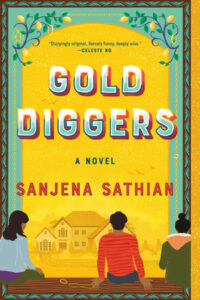
Gold Diggers by Sanjena Sathian (2021) This book had been on my list for a long time. It received a lot of buzz when it came out. Sathian is a new voice on the Asian American writing scene and Gold Diggers is her debut novel. It’s the story of a young boy who grows up in the suburbs of Atlanta who does not adhere to the dreams of his parents or the Indian community that all seem to collectively hold one ambition for their children – that they should go to Ivy League schools. Instead, he aligns himself with the girl next door, who largely ignores him, and her intriguingly outsider mother who brews a mysterious cocktail from melted down gold that has the power, like a genie, to help its imbibers realize their deepest wish. I had mixed feelings about this book. While I admired Sathian’s ambitious plotting, and her willingness to get her protagonist into deep trouble, I found myself frustrated with the stereotypical casting of Indian Americans. The usual tropes of shallow, materialistic, single-minded, success-oriented parents wore thin on me. That said, I feel hers is a voice to follow and I’m looking forward to reading her next novel Goddess Complex.
Our Beautiful Boys by Sameer Pandya (2025) My friend Neelanjana Banerjee, managing editor of Kaya Press, feels there are not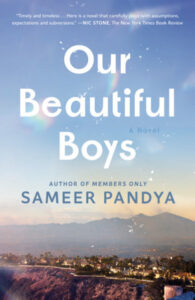 enough books written by Indian male authors who explore the experience of the experience of growing up in a boy’s world. Our Beautiful Boys fills that gap. Here’s a summary of the story: “Vikram Shastri has always been a good kid. He’s got a 4.6 GPA, listens to his parents, barely hits the parties, and is on track for a fancy college. But when he gets the chance to play on his high school football team, his world suddenly starts to shift. Basking in their recent victory, Vikram and his teammates Diego and MJ attend a party at an abandoned house in the Southern California foothills, located right below three ancient caves. They find themselves lost in the dark of night in one of the caves, carried away by male bravado, with a classmate who has annoyed them for years. But when the kid emerges with injuries that prove to be more serious than the all-star boys intended, they are suspended for the rest of the season, and the boys’ parents are brought in to manage the situation. As the parents try to protect their boys, they are also managing their own complicated family and professional lives. While the parents work with, and against, one another to figure out the truth about that night, the boys must come to terms with how much of their own secrets they’re willing to reveal to clear their names.”
I loved the multi-cultural portrait here – an Indian family, a white family and a Hispanic family are brought together to face the prospect that their “perfect” sons might have derailed their futures in one night of violence. Pandya writes a portrait of three families – the parents take equal space to their sons – all navigating their personal histories, aspirations and dreams. While I appreciated the large canvas of this novel, I was disturbed at times by what felt like a subtle misogyny – the men in this novel are aggrieved and the women unsympathetic to their soulful miseries. I wished to know more about this dynamic and what brought it on. I suspect Pandya has an interesting novel in him that excavates the male ethos – I only hope he writes it without pitting the women as the antagonists.
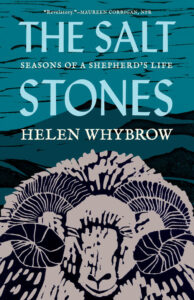 The Salt Stones by Helen Whybrow (2025) This is a memoir written by a shepherdess! “In the heart of Vermont’s Green Mountains, Helen Whybrow and her partner set out to restore an old two-hundred-acre farm. Knowing that “belonging more than anything requires participation,” they begin to intertwine their lives with the land. But soon after releasing a flock of Icelandic sheep onto the worn-out fields, Whybrow realizes that the art of shepherding extends far beyond the flock and fences of Knoll Farm.” I enjoyed reading this book. Whybrow’s voice is honest, quiet and forceful in its examination of what it means to belong on land, to tend to animals, and to experience that over time. In fact, I loved how she handled time in this memoir which starts with her early days on the farm, when she is also a new mother, to several decades later when she must confront her own aging, and her now grown daughter moving away. It’s very well written and satisfying to anyone who loves stories about relationships with land and animals.
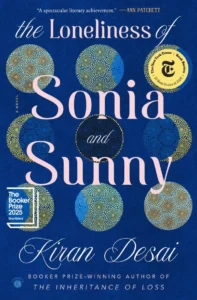 The Loneliness of Sonia and Sunny by Kiran Desai (2025) At 670 pages this novel is a major undertaking but thankfully is mostly a pleasure to read. Will Sonia and Sunny ever find each other, and then, will they ever find each other again after they stupidly part ways — this is the burning plotline of the novel. But the plot is hardly important – what is important is the web of their respective families and how they have a hold on their two children who, having left India to lead searingly lonely lives in America, seem unable to settle into any comfortable notions of identity. There are many passages in which Desai captures beautifully the dilemma of the immigrant: “He (Sunny) often couldn’t determine how he felt exactly about his new life, and it was how he happened to behave then that elucidated his emotions. But he was also unsure whether he was behaving from honest impulse or from playing a part, taking his cues from the people, the weather, the food, even the objects around him… One thing seemed certain: If India existed, then America could not, for they were too drastically different not to cancel each other out. Yet, despite this fact, they refused to remain apart. India invaded his life all the way from the other side of the world, and then life here became instantly artificial, a taunt. He became an imposter, a spy, a liar, and a ghost.” The book was shortlisted for the 2025 Booker Prize and was on many critics best 10 novels. I’m happy I read it — it made me think about the enduring tentacles of Indian families, the tug of India, the complexities of America and how we immigrants find a place for ourselves in this world.
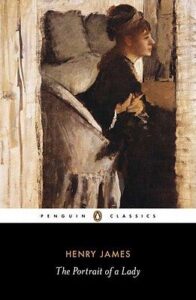 The Portrait of a Lady by Henry James. (1881)Admittedly, I should have read this classic years ago. And I did try, several times, but couldn’t quite get into it. This time was the lucky charm, maybe because I listened to it as an audiobook. It deserves its masterpiece designation. It’s the story of a young American woman who travels to Europe with her aunt to meet her destiny, defined in those days as meeting your husband. But Isabel Archer inhabits a unique mind, one that tells her there is more for her than the right man – a whole life time of experience is waiting for her. James is a master plotter, and Isabel’s destiny is held in the hands of her cousin Ralph who engineers for her to inherit a lot of money and give her the freedom she so desires. So, in the second act, it is baffling to watch Isabel make a disastrous choice. And then in the third, to watch her awaken to the mistakes she has made. What I loved so much about this novel, in addition to the language and the crafting, is the big question James asks about free will and freedom and how we negotiate the choices we make. I loved especially the moments when he allows characters to confront each other deeply and honestly. I longed for Isabel to free herself from her mistakes but also admire that James does not offer her an easy out. One other thing – a line that struck home: “He was assimilated but not converted.” James was writing about Mr. Touchett, an American who had long settled in England, adopted it as a place to make a comfortable life, but not apparently to love, not the people, the culture, the customs. The theme of cultural contrasts and conflicts underlies the whole novel and resonated with me deeply. How do we discover where we belong and do we necessarily need to belong anywhere? James characters seem perfectly comfortable on foreign soil.
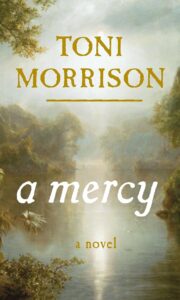 A Mercy by Toni Morrison (2008) I have been in a “private” book club with the wonderful poet and my friend Imani Tolliver for the last few years. We decided we would read Toni Morrison’s novel chronologically and discuss them. “A Mercy” is Morrison’s ninth novel and sharing each one with Imani has been one of the best reading experiences I’ve had. Morrison is not an easy writer in the sense that she inhabits the world of her characters so completely, taking us inside their reality with depth and precision that can leave the reader catching up. Morrison handles time and memory in a way that is fluid and fluctuating; she cares less for plot and more for backstory, revealing histories of characters that have everything to do with the dark American legacy of slavery and racism. “A Mercy” takes place in pre-colonial America, when the landscape was wild and untamed, when white men were laying stake to land and slaves. It’s the story of four women who are brought together by a man who at first seems generous and good hearted but then becomes involved in building an enormous house that serves no one. When he dies of illness and leaves his widow with her three servants, one a Native American woman, the other a young girl who the man had bartered to get and who was separated from her mother at age thirteen, and the third a young girl who seems to have no roots or family. These four women must forge ahead to survive alone in the wilderness. But Morrison does not tell a tale of bonding and redemption—instead each woman survives solely on the strength of her own will. I found it a hard story for that reason – as a reader I selfishly want to believe that people, and especially women, will offer a new paradigm other than “survival of the fittest.” But I’ve read enough of Morrison now to know she is a realist at heart, and if she does allow grace and mercy, it will be hard won. This is the case in this brief novel. Morrison’s project, it seems to me, is to expose the extremity of cruelty in the very roots of this country — that there were no hands holding anyone — and women, blacks, and natives were all left in solitary struggles to move forward in their lives with little or no hope of community. How, after all, can community be built when the savagery they all experienced is unacknowledged and festering in their very beings. It would be an illusion to think they could trust each other — that is the tragedy that Morrison uncovers.
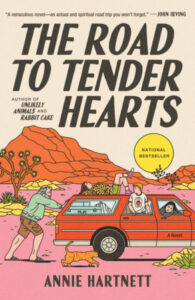 The Road to Tender Hearts by Annie Hartnett (2025) This book came as a recommendation from my daughter Kanchan who loved it. I was a bit skeptical at first – it just seemed too commercial. (You can see my bias.) But I was surprised in the best way. It’s a road trip novel – bringing together an unlikely cast of characters — an older man who struggles with alcoholism and grief, two children who are his brother’s grandchildren left orphaned when their parents die in the most shocking way, his twenty something daughter who is adrift in her life, and a cat, Pancakes, who can foretell death. They head out across country so the old man can reunite with his childhood sweetheart. I found the novel hilarious, real, dark and full of surprises. Annie Harnett seems to have landed on the perfect formula for a heartwarming novel without being cloy, easy or superficial. She digs into the pain and also the humor of lived human experience. I only have admiration for her.
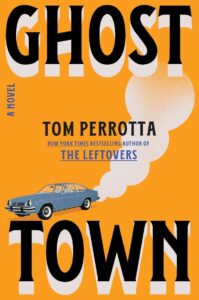 Ghost Town by Tom Perrotta (2026) I met Tom Perrotta many years ago at the Breadloaf Writers Conference when we were just starting out on our literary careers, and it has been such pleasure to watch his success with one good novel after the next. He captures a particular American fabric — one that is foreign to my own experience, but that I feel brought into by his wonderful sense of place and his generosity to his characters. I found Ghost Town to be particularly affecting—it takes place in New Jersey in the 1970’s over the course of a summer when it’s protagonist, a thirteen-year-old boy, loses his mother to cancer. What I loved so much is how Perrotta deftly and boldly tackles the racial unrest underpinning suburban America – even a thirteen-year-old boy cannot escape the consequences of racial hatred that boils over and results in the death of those he loves. Perrotta is such a good writer; funny, warm-hearted, real and generous with a finger on the pulse of America. Full disclosure: he wrote a wonderful blurb for “Sutra Americana!”
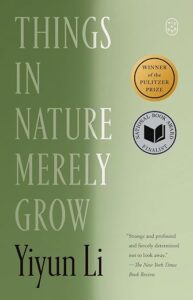 Things in Nature Merely Grow by Yiyun Li (2025) I confess I avoided reading this book when it first came out. It’s Yiyun Li’s account of losing both her sons to suicide. It seemed far too difficult material to confront. If it was difficult to read, I can only imagine what it was to write. I both listened to it as audio and read it. It is one of the best memoirs I’ve read. It is devastatingly honest. Yiyun Li takes an impossible subject to write about, what she calls the extremity of human experience, and somehow finds a way to write about it that is unflinching. The distance she finds is perfect—she brings us in close enough to the experience so we can gain insight into it but also keeps us at enough distance so we cannot feel pity or succumb to false emotion. It is masterful. It is one of those books I feel I need to study to fully appreciate the depth of “how she does it.”
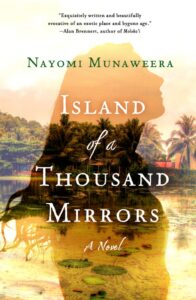 Island of a Thousand Mirrors by Nayomi Munaweera (2012) This is a novel about the Sri Lankan civil war told through the daughters of two families on opposing sides of the conflict. Munaweera’s evocative language mirrors the beautiful tropical landscape of a country bounded by the sea on all sides. She moves with ease between characters and their destinies, forged in circumstances largely beyond their control. I liked the scope of this novel, taking us between Sri Lanka and America, and always aware of the fragility of act of storytelling—the importance of fairness to all sides. What is reflected in the thousand mirrors of the title, is the infinite dimension of the pain of war.
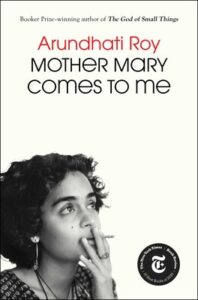 Mother Mary Comes To Me by Arundhati Roy (2025) It took me two tries to get into this memoir. Urged on to finish it by friends, I did, and I’m overall glad I did. Roy tells the story here of her upbringing by an extremely complicated mother who she calls Mrs. Roy in the book. The formality of address says everything. No Mum, Mummy, Mom here. Like Roy herself, Mrs. Roy is a fighter and activist for a different India. She is filled with fire and confidence, but she is also an unloving and cruel mother. Between those two extremes, Arundhati Roy must figure out how to make a life for herself. And the life she makes is extraordinary. It doesn’t take much to read between the lines that Roy herself is a charismatic and forceful person who draws to herself all kinds of artists and activists, friends and enemies. It is fascinating to read how the legacy of her mother’s cruelty ripples through her own relationships. There is much in this memoir that Roy does not say – while she is honest, she also leaves herself a mystery to the reader. What I craved most were more scenes like the one in which she describes her mother cruelly berating her for not speaking up in the presence of the architect who will design Mrs. Roy’s school. Mrs. Roy is so incensed at her fifteen-year-old daughter’s silence that she kicks her out of the car and leaves her on the side of the road for hours. How to explain how the brother, even more hated by the mother, allows his wife to work for her? Vivian Gornick writes about the “depth of inquiry” that a writer of the memoir must engage in – asking the central question of “who am I.” I wish Arundhati Roy had engaged more deeply with this question.
 Immigrant Montana by Amitava Kumar (2017) I picked up this book as I was looking for books on the immigrant experience. It’s the story of a young man who comes to America to study literature in New York City. An early paragraph offered some promise: “For so many years, the idea of writing has meant recognizing and even addressing a division in my life: the gap between India, the land of my birth, and the United States, where I arrived as a young adult. If and when I imagine an audience for my writing, it is a divided one. But the two places are connected, not only by those histories that cultural organizations celebrate through endlessly dull annual gatherings but the millions of individual yearnings, all those stories of consummated or thwarted desire.” But it turns out the book is more an exploration of the narrator’s sexual encounters with women. America becomes a place of his sexual awakening, made easy by American women who are not held back by the strictly observed norms of Indian culture. The chapters are even named after the women. The book also narrates the awakening to ideas about politics, colonization and literature. This book is called a novel, but it reads very much like memoir. I was made uneasy by this blurry line, unclear what truth Kumar was trying to uncover. In the end he writes: “But first aren’t we condemned to repeat our stories and write the same book over and over again? Or, to put it differently, don’t we fall in love every time with the same person and make the same mistakes? …I have always wanted to be in love; all I have managed to do is tell a story.” In fact, all the women in the book seem to be in the same mold – beautiful, intelligent, alluring who he pursues and then betrays. The narrator comes to no reckoning of self, leaving this reader unclear why we have been on this journey with him.
 Home by Toni Morrison (2012) The tenth of Toni Morrison’s novels, and the second I’ve read this year, Home centers on the story of a Korean War veteran who returns to the United States shattered by his experience. Suffering from nightmares and hallucinations, he is barely surviving, always on the verge of being arrested. We meet him as he decides he must return home to Lotus, Georgia to rescue his little sister, Cee. As the novel unfolds, we learn more about their relationship, home life, and circumstances. In classic Toni Morrison style, the story is told in fragments, in multiple voices, and with a great deal of interiority.
I read this novel having just listened to Ezra Klein interview Bryan Stevenson – the founder of the Equal Justice Initiative. In the interview he mentions that veterans returning from WWII and Korea were targeted in the south for lynching, despite having just served the country. White southerners were threatened by black men who had been trained to use guns and knew how to defend themselves. He also talks about the incredible resilience and courage of Black Americans, from the time of slavery until today. More than anything, I read Home as a testimony to that. The main character is so abandoned by the country he risked his life for and yet finds a way to rescue his sister from an evil doctor who has used her body for his experiments. This act of restoring the one good thing in his life, his little sister, is an act of heroism and hope.
 Surrender by Brian O’Hare (2022) This is a powerful book of short stories centered around the young narrator’s experience in the Gulf War. In true war story fashion, O’Hare captures the absurdity and disconnect that a soldier faces in a war that is without meaning or reason. The writing is alive and vivid and takes the reader into a young man’s life as he comes of age in the desert among fellow warriors who provide both brotherhood and also a sense of complete aloneness. The book deservedly won the Syracuse University Press 2021 Veterans Writing Award. I know Brian through Jim Krusoe’s writing workshop, and love his bold language and gritty determination to bring experience alive on the page.